What Happens When Your Child Goes Quiet?
You may be looking for one emotion, when multiple emotions are driving behavior.

You ask how your child feels. They shrug. They say, “I don’t know.” Or they give you the answer that ends the conversation fastest: “Fine.”
That can look like refusal. It can sound as though the child does not know the word. But sometimes the problem is the question. You asked for one feeling when multiple feelings were happening simultaneously. Choosing just one would leave something important out.
One Face Can Hold More Than One Feeling
Children are often taught feelings one at a time. A smiling face means happy. A frowning face means sad. A frightened face means scared. The pictures are useful, but they can quietly teach another rule: one face, one feeling, one correct answer.
Real feelings do not stay in their own boxes. A child can be excited about the first day of school and afraid to walk through the door. They can love a friend and still be angry with them. They can want you to leave and want you to stay close enough to hear them call.
If the only available answer is one word, silence may be the most honest answer they have.
The Kind Boy and the Housemaid Have No Simple Answer

In The Kind Boy Escapes the Witch, the Kind Boy and the housemaid run all night. They have promised never to leave each other, but the witch’s servants are following them.
At the edge of the road, they stop to rest. Then they look up and see the servants coming. The housemaid says, “We must do something quick.” The Kind Boy uses his first wish, and the two of them become a rose tree and a rose.
Everything is happening in the same second. They are being hunted. They are together. They are frightened. They are in love. Nothing about that moment can be summed up in one word.
Two Things at Once
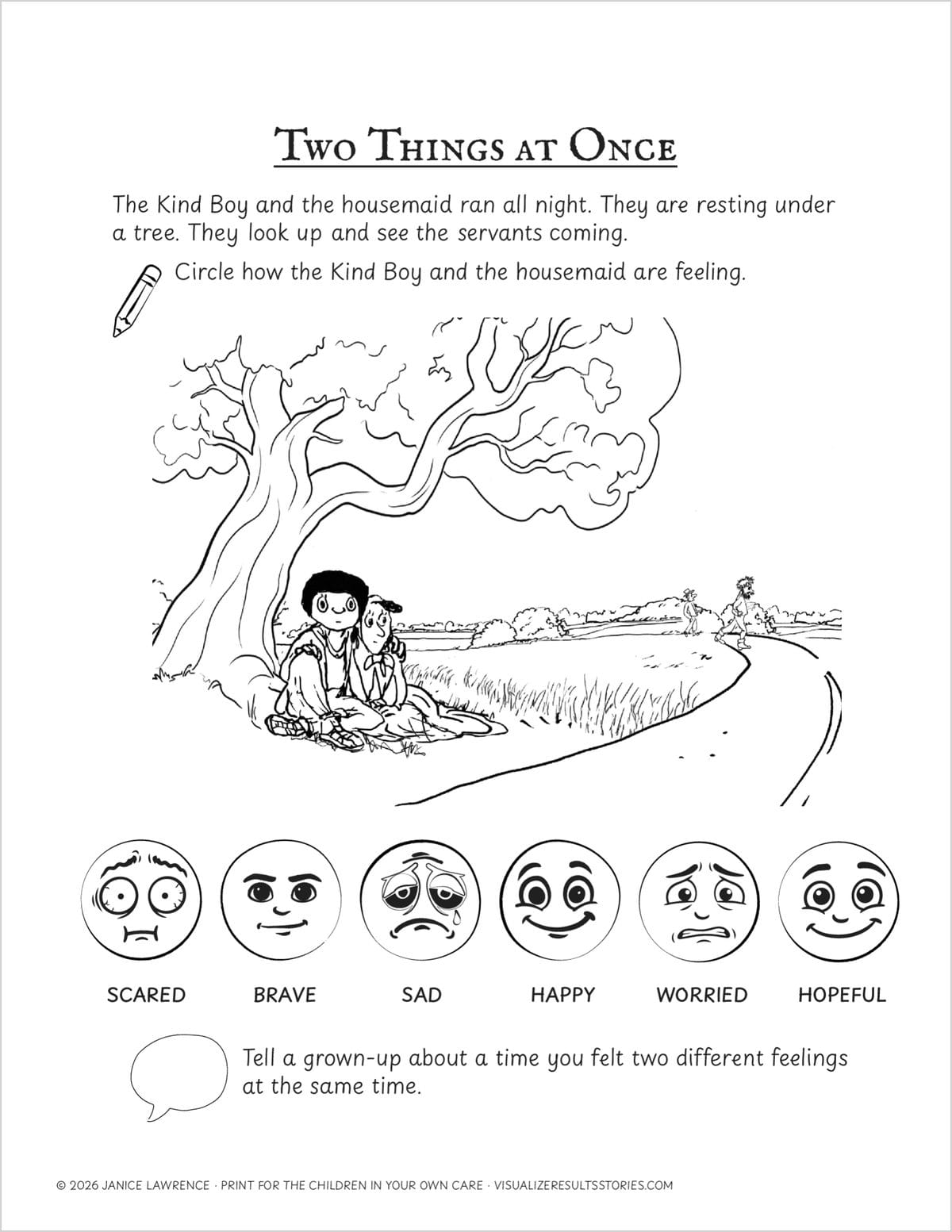
The free Two Things at Once activity begins at that moment beside the road. Under the picture are six faces: scared, brave, sad, happy, worried and hopeful.
The direction says, “Circle how the Kind Boy and the housemaid are feeling.” It does not say to circle one. That small omission is the activity. The page gives your child permission to choose two feelings, or three, or a combination you did not expect. The words are already there, so the child does not have to retrieve the vocabulary and explain the whole scene at the same time.
After your child circles the faces, ask, “What is happening that could make them feel that one?” If they point instead of answering, the point still counts. If they change their mind, that counts too.
Ask the Question in the Plural

Try changing one familiar question this week. Instead of asking, “How do you feel?” ask, “Which feelings are here?”
The plural changes the job. Your child no longer has to find the single word that explains everything. They can give you a list. Scared and excited. Angry and lonely. Happy and worried.
You may finally hear something more useful than “fine.”
Does This Sound Like Your Child
This activity may help a child who:
- Answers “fine” or “I don't know.” The six faces give the child somewhere to begin without retrieving every word alone.
- Feels two things that seem to contradict each other. The page allows scared and brave, happy and worried, or another combination to exist together.
- Points more easily than they explain. Circling or pointing can carry the answer before a sentence is ready.
- Changes their mind after looking longer. The activity makes revision part of interpreting, not a mistake.
- Becomes quiet when a question seems to have one correct answer. Asking which feelings are present removes the demand to choose only one.