What If Talking About a Story Didn’t Feel Like a Quiz?
Lots of kids shut down the second you ask “what happened?” It sounds like a test with a right answer. There is a way to talk about a story that doesn’t.

Ask a lot of kids what a story was about and you will get a shrug, even when you know they were paying attention. It is not that they did not understand it. It is that “what happened?” feels like a test with a right answer, and some kids would rather say nothing than risk a wrong one. There is a way to talk about a story that does not feel like that at all.

What a Read-Along Gives You to Talk About
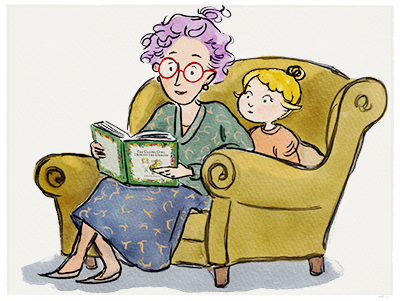
A read-along video takes the pressure off in two ways at once: your child is not decoding words, and you are not quizzing them afterward. Watching something together gives you something to wonder about together.
Why Out-Loud Practice Beats a Pop Quiz Every Tim
- There is no wrong answer in a conversation the way there is on a worksheet. That alone gets more kids talking.
- Watching a story together gives you a shared reference point. “Remember when the Witch thought…” is easier to return to than something your child read alone and has to summarize cold.
- It is rehearsal for something bigger. What a character believes versus what is true is something your child is sorting out every day, in conversations that matter more than this one.
This Week’s Story
This week’s read-along is The Clever Girl Outwits the Witch, one of four illustrated fairy tales in my Clever Girl series.
In this tale, the Witch believes she has met a handsome young suitor. She is wrong, and the whole story runs on the space between what she believes and what is so.
Watch It Together, Then Just Talk
Watch it together once before you talk about anything. Then, instead of “what happened,” try questions that invite a guess rather than a report. “What do you think the Witch believes is going on?” lands very differently from “what did the Witch think?” The first invites a theory. The second sounds like a test.
A few worth trying, once or twice, not after every scene:
- “Why do you think the Witch believes what she believes?”
- “What does the Clever Girl know that the Witch doesn’t?”
- “If you were the Clever Girl, would you tell her the truth, or let her figure it out?”
Today’s Free Activity: Broom Race!

An outdoor game with three different races using a broom, or any long stick. A fast race where the first one across wins. A relay where partners pass the broom and have to cooperate. And a slowest-wins race, where going slow on purpose turns out to be its own kind of hard.
Play all three, or just the fast one. Each teaches something different, and one rule at a time is a complete game.
Does This Sound Like Your Child?
This activity helps all kids practice regulation, cooperation, and the surprising challenge of moving slowly on purpose. It is especially good for children who have:
- ADHD — kids whose energy needs somewhere real to go. Three race formats give restlessness a job, then a different job, then a third.
- Autism Spectrum — kids who do better with one clear rule at a time. Each race has exactly one rule, and it does not change mid-round.
- Anxiety — kids who worry about doing something wrong. Fast, together, or slow all count as winning, depending on which race you are playing.
- Low Confidence — kids who are used to losing the games that reward speed. The slowest-wins race gives a different kind of kid a real shot at winning, often for the first time.
Why This Matters More Than Getting the Answer Right

- A child does not need to explain a story perfectly to understand it. Watching, playing, and talking it through are just as real as answering questions about it, and often more revealing.
- The read-along and the broom race do the same job from two directions. One lets your child watch someone hold two realities at once. The other lets them practice patience and cooperation in their own body.
Try It This Week

- Watch the read-along together. No debrief required afterward.
- Ask one guess-inviting question, not a full retelling.
- Download Broom Race! and run at least the fast version outside. Add the relay and the slow race another day.