What If Your Child Could Watch the Same Day End Two Different Ways?
The two endings begin at the two doors.

You explain a consequence. Your child understands every word. They may even repeat it back to you. Then the moment comes, and they make the same choice again. That does not necessarily mean they ignored you or forgot what you said. An explanation asks a child to carry an idea from one moment into another. A story can put the choice and the consequence where the child can see both.
The Kind Boy Teaches the Giant a Lesson does something even more useful. It gives two people almost the same opportunity and lets us watch what each one does with it.
Two Doors on the Same Road
A boy is walking at dusk when he comes to two houses facing each other across a road. One house is large and beautiful. The boy decides that one more guest will be no trouble there, so he knocks on the door. A rich giant answers. The boy asks for a place to sleep. The giant tells him that he would not have such a fine house if he fed everyone who came to his door. Then he sends the boy away. Across the road is a much smaller house. The couple who live there have little to share, but they invite the boy inside. They give him supper and let him sleep in their bed while they sleep on the floor.
In the morning, the boy offers them three wishes. The man wishes for a long, healthy life. Then he wishes for bread on the table every night. That is all he and his wife need. The boy has to suggest a third wish himself: a new house to make their lives more comfortable. Then the giant sees the new house across the road. He discovers where it came from, realizes what walked away from his own door the night before, and runs after the boy to ask for three wishes of his own. The boy gives them to him. By the end of the day, the giant has lost all three.
The Same Gift Does Not Produce the Same Ending
Both men meet the same boy. Both are offered three wishes. The difference begins before anyone knows that wishes are coming. One man looks at a tired child standing on his doorstep and sees someone who needs supper and a bed. The other calculates what helping strangers might cost him.
The poor man does not share because he expects a reward. He does not know there will be one. The giant becomes generous only after he sees the new house. A child does not need to know the words: motive, cause, or consequence to notice that difference. The two doors make it visible.
Stop the Story Twice
The first time you watch the read-along, let the story be a story.
Then view it again. Stop after the boy has knocked on both doors but before anyone receives a wish. Ask: “What was different about the two doors?” “What did each man decide?” “Do either of them know what will happen in the morning?”
Then stop again after the giant receives his wishes. Ask: “What do you think he will wish for?” “What happened when the other man received his wishes?” “Do you think this will end the same way?”
The prediction does not have to be right. Your child is using what has already happened to imagine what could happen next. That is the thinking.
Three Things to Talk About Afterwards
The poor man stops after wishing for health and bread. Ask, “What would your third wish be?” There is no correct answer. The choice may be practical, enormous, funny, or entirely impossible. Let it belong to your child.
The giant asks for wishes only after he sees the new house. Ask, “What do you think he wanted the wishes to give him?” This moves past what the giant did and asks what he expected to happen.
Then return to the two doors. Ask, “When could the giant have changed the ending?” Your child may choose the first knock, the promise he makes to the boy, one of the wishes, or another moment entirely. More than one answer can work.
Same Wishes
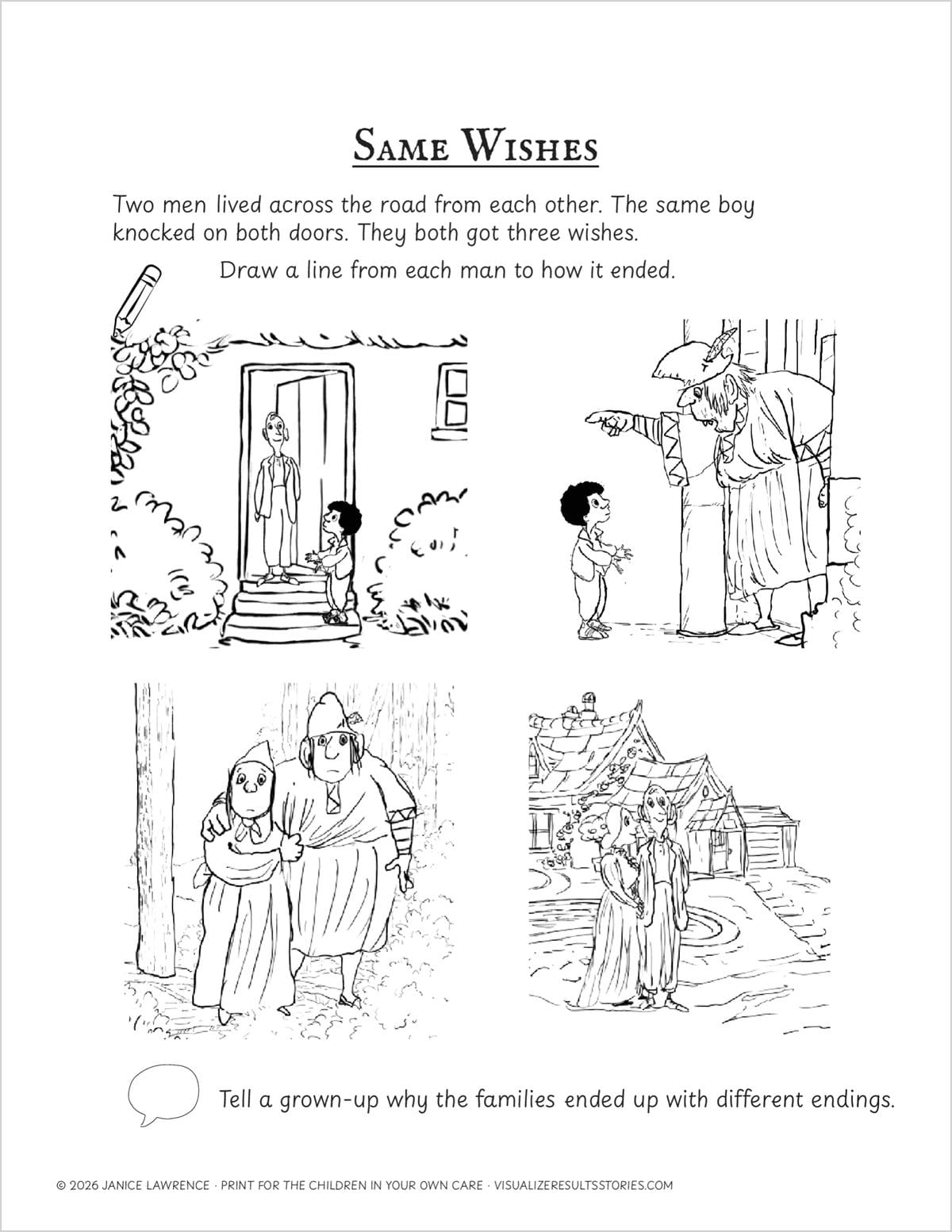
The free Same Wishes activity puts the whole comparison on one page. Across the top are the two doors: the same boy asking for shelter, one man welcoming him and the other turning him away. Across the bottom are the two endings.
Your child draws a line from each man to his ending. Then you can ask, “Why did the same three wishes end so differently?”
A child who reads every word of a story may still have trouble holding two choices and two endings in mind long enough to compare them. On this page, nothing has to be remembered while something else is examined. Both paths remain visible.
A child who is not reading yet can do the same thinking. Four pictures. Two lines. One question.
What Your Child Is Practicing
This activity uses the Learning Action Predicting. Predicting is not guessing what the author has hidden. It is looking at what has already happened and using it to imagine what may happen next. Your child notices what stayed the same, what changed, and which choice may have led to which ending. If the lines are crossed, do not correct them immediately. Ask your child to tell you why those pictures belong together. A wrong answer can still contain good thinking.
Does This Sound Like Your Child
This activity may help a child who:
- Follows each part of a story but loses the comparison. The two doors and two endings remain visible on the same page.
- Understands pictures more easily than a spoken explanation. Four pictures and two lines carry the cause and effect.
- Predicts quickly without explaining the connection. Asking why two pictures belong together reveals the thinking behind the line.
- Worries that a wrong prediction means they failed. The activity treats the answer as a reason to look again, not the end of the conversation.
- Notices a detail the grown-up missed. The page leaves room for a connection that is different but still supported by the story.
Try It This Week

Watch the story together. Stop once at the doors and once before the endings. Then print the activity and let your child draw both lines before you explain anything.
When they finish, ask, “Why did you connect those two?” Wait for the answer. Your child may point to something in the picture that you did not notice.