What Do You Say When Your Child Lends Their Favorite Toy and Does Not Get It Back?
A promise cannot guarantee what will happen, but it can set expectations.

The teddy bear is still between them. One child has started to let go. The other has started to take it. This is the moment that matters. Not because one child can look at the other child’s face and know whether the teddy bear will come back. Adults cannot do that either. What the child can do is say what they need before their hands open: “You can borrow him. Please bring him back before bedtime.” Now both children know what has been promised.
Be Careful Is Not Much of a Plan
You may already know how this afternoon is going to end. The same friend borrowed something last month and forgot to return it. Your child wants to lend the toy anyway. You can stop the exchange. The toy will be safe, but your child will not have made the decision. You can let it happen without saying anything. That may feel like standing nearby while your child is taken advantage of.
Or you can help your child make the agreement more specific. “What do you need your friend to promise?” Not “Do you trust them?” Not “Are you sure this is a good idea?” Trust is difficult to measure. A condition can be said out loud: bring it back after dinner, do not lend it to somebody else, let’s trade and trade back before you go home, or do not take it outside. The condition does not make the promise unbreakable. It gives both children the same promise to remember.
The Giant Makes a Much Bigger Promise Than Anyone Asked For

In The Kind Boy Teaches the Giant a Lesson, the giant turns the boy away from his door. The next morning, he sees that the poor couple across the road have received three wishes for helping the boy. The giant runs after him and asks for three wishes of his own. The boy does not answer immediately. He remembers what happened at the giant’s door. Then he agrees on one condition: the giant must promise to use the wishes wisely.
The giant could simply say yes. Instead, he makes the promise much larger. He says that he will wish only for things that bring happiness to other people. Then he adds his own penalty. If he breaks his promise, his house will become a hovel and his money will go to the poor. Nobody asked him to promise all of that.
Before the day is over, the giant has wasted all three wishes. The boy returns and holds him to the terms the giant chose himself. The Kind Boy asked for a promise. He made the condition clear. The giant broke it anyway. That matters.
A promise gives us something to agree to. It does not give us control over what another person will do.
The Promise
The free activity The Promise begins with the agreement between the boy and the giant. On the first page, the giant is already imagining the penalty he added: his beautiful house in ruins and his money being given away. Below that are the three wishes. Your child decides whether each wish was wise and whether the giant kept his promise.
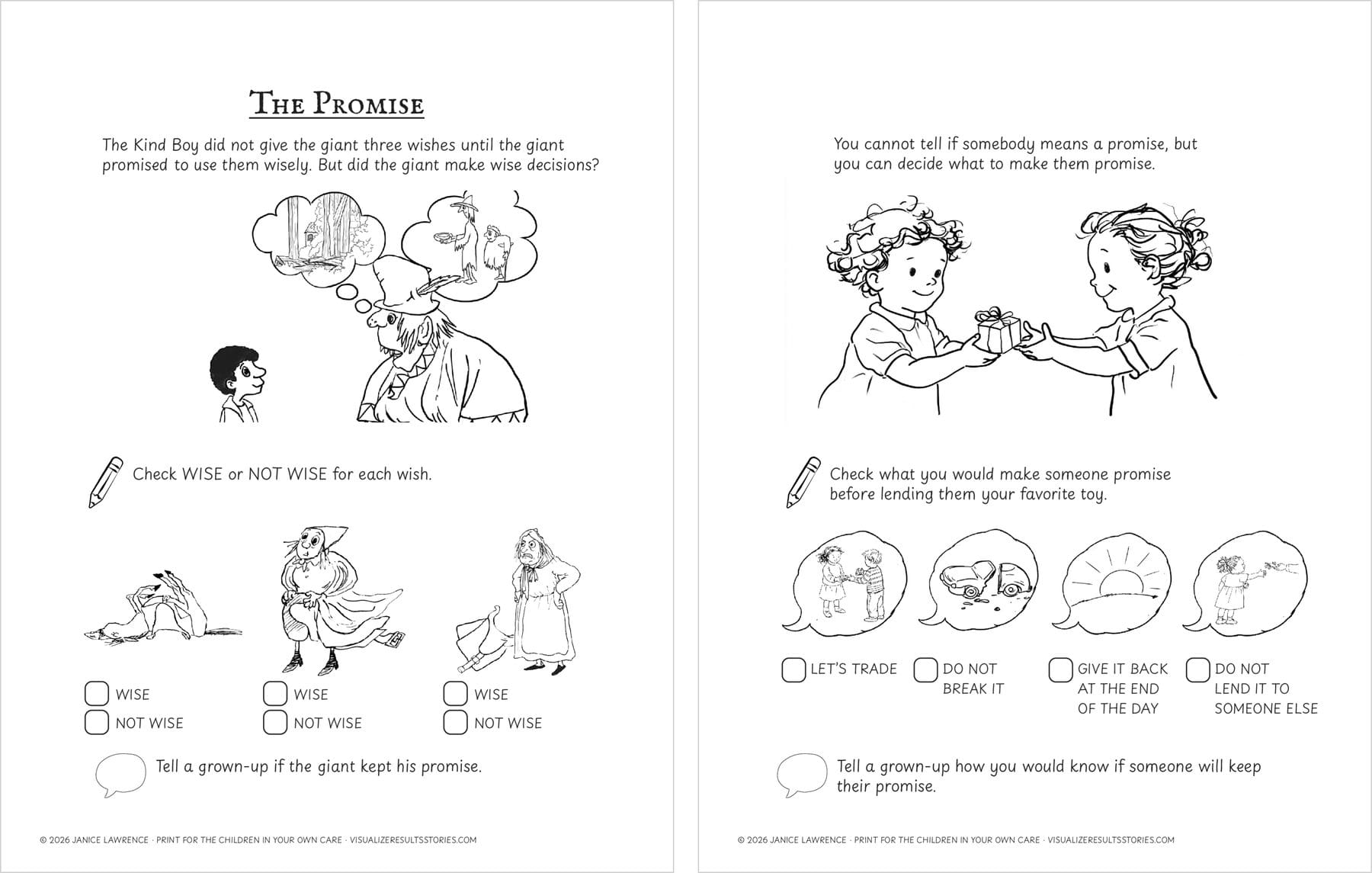
Then the second page brings the problem into a child’s world. A favorite toy is about to be lent to somebody else. Four possible conditions are printed beside it: let’s trade, do not break it, give it back at the end of the day, and do not lend it to someone else. Your child chooses the condition they would use. They may choose differently from you. Ask why before offering your answer. The toy belongs to the child in the picture, and the decision belongs to your child.
Then comes the harder question: “How can you tell if somebody will keep a promise?” There is no way to know for certain. That is not a trick. It is the point.
What a Child Can Control
A child cannot control whether another person keeps a promise. They can decide what they are willing to lend. They can ask for a clear agreement. They can choose when the toy needs to come back. They can decide what to do the next time if the promise is broken.
The goal is not to teach a child how to identify untrustworthy people by looking at them. It is to give the child words they can use before something important leaves their hands.
The Part That Is Hard for the Grown-Up
I have wanted to stop the exchange before it happened. When you can already see the missing toy, the broken promise, and the hurt child at the end of the afternoon, stepping in can feel like the sensible thing to do. Sometimes it is. A grown-up still has to step in when something is unsafe or the cost is too high. But protecting a child from every broken promise also takes away the chance to decide what matters, ask for what they need, and notice what happens next. I cannot tell a child which people will always keep their promises. I can help them put the promise into words before they let go.
Does This Sound Like Your Child
This activity may help a child who:
- Wants to share but has trouble stating the conditions. The printed choices give the child words to use before the toy leaves their hands.
- Says yes because saying no feels too difficult. Choosing a condition creates a middle ground between refusing and giving up control.
- Treats trust as all or nothing. The page moves the conversation from judging a person to making one clear agreement.
- Needs time to decide what matters most. Returning the toy, protecting it and keeping it with one person are different needs.
- Looks to an adult to make the decision. The grown-up can help with the words while leaving the condition with the child.
Try It This Week

Look at the second activity page together and let your child choose the condition. Ask, “Why would you choose that one?” and “What would you say before you handed over the toy?”
If your child wants to lend something later, help them remember the sentence. Do not decide the condition for them unless safety requires you to step in. Then let the other child answer. The promise belongs to both of them.